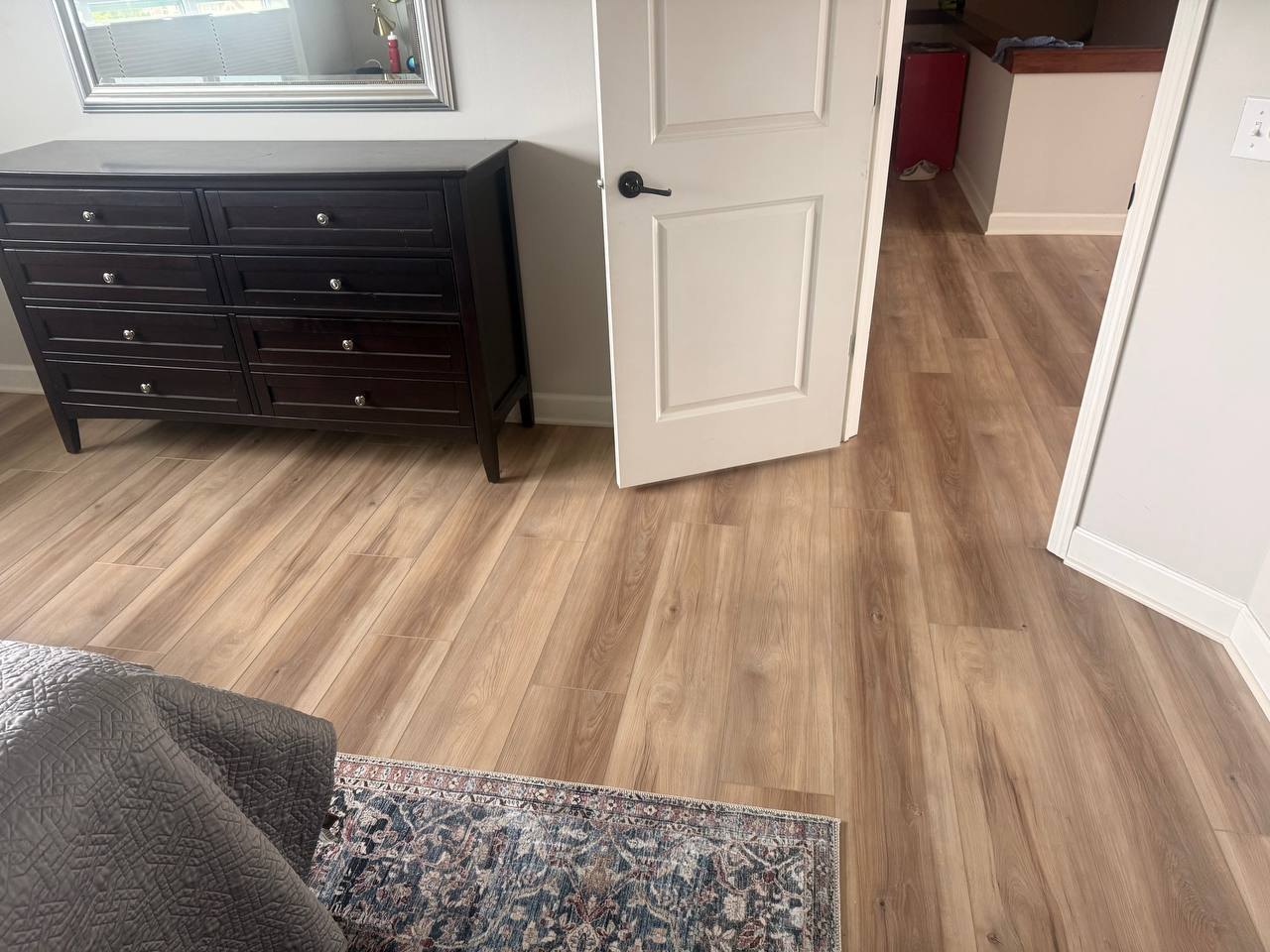
Rigid core vinyl plank flooring is the category most homeowners land on once they've decided against carpet or laminate but haven't yet picked a product family. Here's the part the showroom rarely tells you: the visual layer you're touching on the sample board matters far less than the core underneath it, and that core is what decides whether the floor telegraphs every bump in your subfloor or lies flat over a 1970s Chanhassen basement slab. Anton Korotchuk has installed glue-down and snap-together vinyl plank, WPC planks, and COREtec and Adura Max rigid core across the west metro, and this guide walks you through the same trade-offs he weighs on the job before recommending a product.
What is rigid core vinyl plank flooring?
Rigid core vinyl plank flooring is a click-together LVP built around a solid, dimensionally stable center layer instead of the thin flexible backing you get on standard glue-down vinyl. That rigid center is what lets the plank float over a subfloor without bonding to it, and it's the reason this category handles temperature swings and minor floor imperfections better than older peel-and-stick or loose-lay vinyl. Every rigid core plank shares the same basic stack: a wear layer on top, a printed design film, the rigid core in the middle, and often a pre-attached underlayment pad on the bottom.
The reason this matters in Minnesota specifically is the seasonal swing. A three-season porch in Victoria or an uninsulated Excelsior basement can run cold in January and warm in July, and a flexible vinyl expands and contracts enough over that range to open small gaps at the seams. A rigid core moves far less, which is why we steer most homeowners here toward it over cheaper flexible LVP for anything below grade or over a slab.
WPC vs SPC vinyl plank: the real difference on the bench
Both WPC and SPC are rigid core and both are generally waterproof. The difference is what the core is made of and how it behaves under your foot and over your subfloor.
WPC (wood-plastic composite)
WPC uses a wood-plastic composite core that's foamed, so it's thicker, lighter, and noticeably warmer and softer underfoot. That cushion is why WPC feels closer to real hardwood when you walk on it, and it's a good fit for main-floor living spaces where comfort matters. The trade-off: a softer core dents a little more easily under heavy point loads like a refrigerator leg or a piano caster.
SPC (stone-plastic composite)
SPC uses a stone-plastic composite core that's denser and harder. It's thinner, more rigid, and far more resistant to dents and to telegraphing the subfloor underneath, which is exactly why it's our default over an old, slightly uneven basement slab. The catch is that a hard core reads harder and colder underfoot and transmits more sound, so a quality attached pad matters more with SPC than with WPC.
The short version from the bench: over a joisted main floor where comfort and warmth win, WPC is often the better feel. Over a slab or a basement subfloor with imperfections you don't want to see through the finished floor, SPC is the safer core because it won't flex into every low spot.
COREtec, Adura Max, and where they fit
COREtec and Adura Max are two of the rigid core lines we install most often, and they sit at the higher-quality end of the category rather than being a separate technology. COREtec helped popularize the WPC-style rigid core with an attached cork underlayment on many of its lines, which quiets the floor and adds a touch of underfoot warmth. Adura Max, from Mannington, spans both softer WPC-style and denser rigid formulations depending on the collection, so the right pick depends on the room, not just the brand name. We install these alongside our full rigid core lineup, and you can see the products and finished projects on our luxury vinyl plank page: read more about our rigid core, COREtec, and Adura Max installation.
If you'd rather have a true tile look with grout lines and a fully bonded floor, that's a different product path. A glue-down luxury vinyl tile, with or without grout, gives you a harder, more tile-like result that suits bathrooms and entryways. Compare the glue-down luxury vinyl tile option if that's closer to what you're picturing.
Which core should you pick for your home?
Match the core to the room and the subfloor, in this order:
- Slab-on-grade or basement over concrete: choose a dense SPC or a quality rigid core line. It hides slab imperfections and shrugs off the cold-to-warm swing below grade.
- Main-floor living areas over a wood subfloor: WPC or a WPC-style COREtec or Adura Max gives you the warmest, quietest, most hardwood-like feel.
- Kitchens, mudrooms, and full baths: any rigid core works because the category is waterproof, but favor a harder core and confirm the wear layer suits a high-traffic wet zone.
- Rental units and high-traffic spaces: rigid core is forgiving of subfloor flaws and quick to install, which is why it's a workhorse in rentals across the west metro.
When rigid core vinyl plank is the wrong call
Rigid core isn't the answer for every floor, and we'll tell you when it isn't. If your heart is set on the exact look, feel, and refinishability of real wood and your subfloor is sound, engineered hardwood is the better long-term buy, since you can sand and refinish it decades later and vinyl you can't. And if your existing subfloor has a serious moisture problem or a large slab deflection, no floating floor fixes that, rigid core included. That needs to be addressed before any plank goes down, or you'll be pulling it back up. When rigid core is right, it's excellent. When it isn't, we'd rather point you to the product that is.
Frequently Asked Questions
Is rigid core flooring waterproof?
Yes. Rigid core vinyl plank, both WPC and SPC, is generally waterproof because the core itself doesn't absorb water and swell the way a laminate fiberboard core does. That's what makes it a genuine option for bathrooms, kitchens, mudrooms, and basements. The one caveat: waterproof planks still float over your subfloor, so a large standing-water event can travel through the seams to the subfloor beneath. The plank survives; the subfloor still needs to dry out.
COREtec vs Adura Max: which is better?
Neither is universally better, they're aimed at slightly different priorities. COREtec's attached cork underlayment on many lines makes for a quiet, slightly warmer floor and a wide range of realistic wood looks. Adura Max, from Mannington, spans both softer WPC-style and denser rigid formulations, so it can be dialed to the room, and Mannington's design range is strong. The better choice depends on your subfloor, the room, and the exact collection, not the logo. We install both and will match the line to your specific floor rather than push one brand.
Does rigid core vinyl plank need a special subfloor?
It's more forgiving than most floors, which is a big part of its appeal, but it isn't magic. Rigid core, especially a dense SPC, bridges minor unevenness that would show through a flexible vinyl. It still can't span a badly out-of-flat slab or a deflecting subfloor. We check flatness and moisture first, correct what needs correcting, and then install, so the finished floor lies flat and stays that way.